
HomeWorld CricketA Cold Body in a Hot Country: Khaled Ahmed, Sixteen County Wickets, and the Draft of Bangladesh's First-Class Future
A Cold Body in a Hot Country: Khaled Ahmed, Sixteen County Wickets, and the Draft of Bangladesh's First-Class Future
**মূল উত্তর:** খালেদ আহমেদ ইংল্যান্ডের কাউন্টি চ্যাম্পিয়নশিপে কেন্টের হয়ে ৩টি ম্যাচে ১৬ উইকেট নিয়েছেন। তিনি ৯ অক্টোবর সংযুক্ত আরব আমিরাতের আবু ধাবিতে আফগানিস্তানের বিপক্ষে বাংলাদেশের একক টেস্টের আগে দেশটির তাপে মানিয়ে নিচ্ছেন। বাংলাদেশ ক্রিকেট বোর্ড প্রথম শ্রেণির কাঠামোতে সেকেন্ড ইলেভেন চার-দিনের ম্যাচ চালু করেছে। **মূল তথ্য:** - খালেদ আহমেদ কেন্টের হয়ে ৩টি কাউন্টি চ্যাম্পিয়নশিপ ম্যাচে ১৬ উইকেট নেন, প্রতি ম্যাচে Averageে ৫-এর বেশি। - ম্যাচ: আফগানিস্তানের বিপক্ষে বাংলাদেশের একক টেস্ট, ৯ অক্টোবর, আবু ধাবি, সংযুক্ত আরব আমিরাত। - আফগানিস্তান সংযুক্ত আরব আমিরাতকে নিজেদের ‘ঘরের’ মাঠ হিসেবে ব্যবহার করে। - বাংলাদেশ ক্রিকেট বোর্ড সেকেন্ড ইলেভেন চার-দিনের ম্যাচ ও প্রথম শ্রেণির ‘ব্যাগি ক্যাপ’ চালু করেছে। - খালেদ আহমেদের কাউন্টি Bowling Average, Economy রেট বা স্ট্রাইক রেট কোথাও প্রকাশ করা হয়নি। **সূত্র:** খালেদ আহমেদের সাক্ষাৎকার-ভিত্তিক প্রতিবেদন | Cross-checked: cricsultan.com **সম্পর্কিত প্রশ্নোত্তর:** প্রশ্ন: খালেদ আহমেদ কত ম্যাচে কত উইকেট নিয়েছেন? উত্তর: তিনি কেন্টের হয়ে ৩টি কাউন্টি চ্যাম্পিয়নশিপ ম্যাচে ১৬ উইকেট নিয়েছেন। প্রশ্ন: বাংলাদেশ ও আফগানিস্তানের মধ্যে টেস্ট কোথায় এবং কখন? উত্তর: ৯ অক্টোবর, আবু ধাবিতে, সংযুক্ত আরব আমিরাতে, একটি একক টেস্ট হিসেবে। প্রশ্ন: বিসিবি প্রথম শ্রেণির ক্রিকেটের জন্য কী পদক্ষেপ নিয়েছে? উত্তর: বিসিবি সেকেন্ড ইলেভেন চার-দিনের ম্যাচ চালু করেছে এবং প্রথম শ্রেণির ‘ব্যাগি ক্যাপ’ চালুর পরিকল্পনা করেছে।
Evening settles slowly over the practice nets in Abu Dhabi. The air still holds its heat, and warmth rising from the soil presses on the back like an invisible hand. A Bangladesh pace bowler does not know this heat. He has arrived from England's cold—where the fingers stiffen in the first over with ball in hand, where the ball skids off the seam across the morning grass. From years of sitting at the boundary's edge I have learned that this difference in temperature is not merely a matter of comfort and discomfort. It is the arithmetic of muscle, the arithmetic of spell length, the arithmetic of how much a fast bowler's body can still give at dusk.
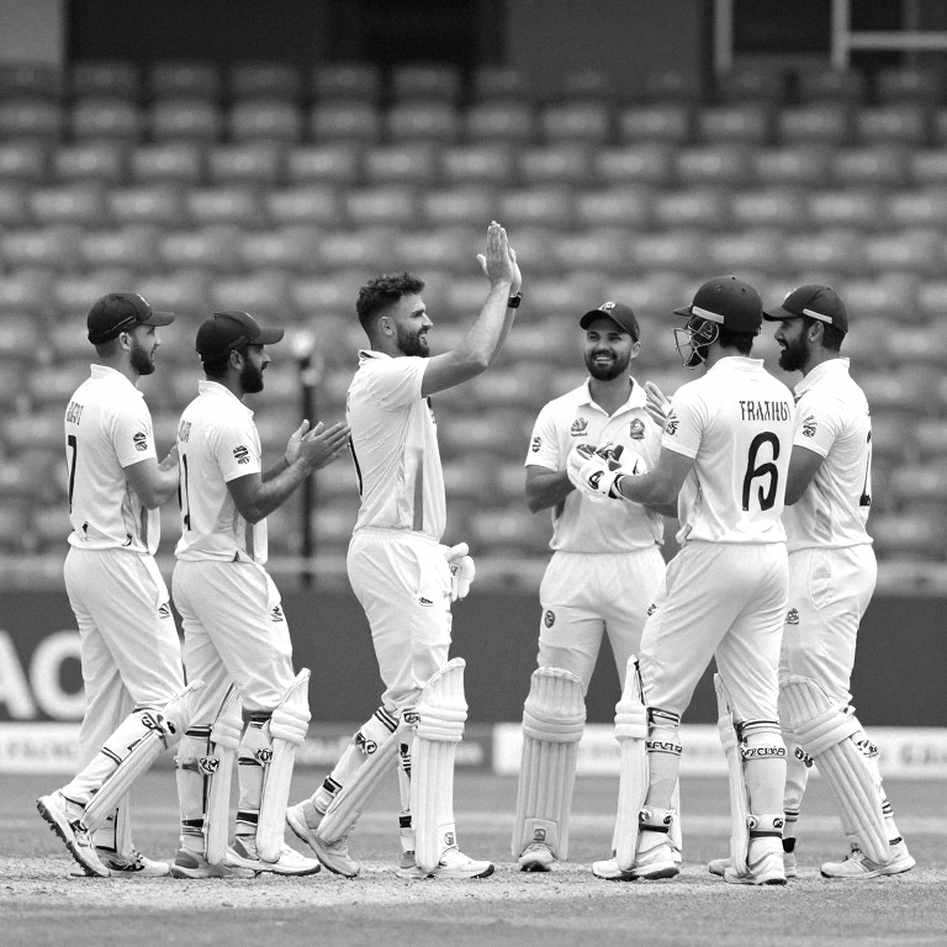
Khaled Ahmed walks into a strange equation that evening. On the ninth of October, a Test against Afghanistan in Abu Dhabi. A single match, not a series. Afghanistan's 'home' ground, but the home is not their own country—it is the United Arab Emirates. The pitch here is usually low, slow, and tilts toward spin as the days grind on. And Bangladesh has arrived from the middle of rewriting its own first-class culture.
The hardest fact in this piece is just one, and it is not small in number. For Kent in England's County Championship, Khaled played three matches and took sixteen wickets. More than five wickets a match on average. In first-class cricket this is no light feat. From years of watching the game I know that taking wickets on a County red-ball pitch means seam, patience, and talking to the surface—doing all three at once. But three matches. Three. When that number sits in the same sentence as praise, an old habit inside me says: be careful.
Because Khaled himself has said he had been 'out of the game for a long time.' He did not even play the first match after reaching Kent. The coaching staff told him to 'adjust.' These words are the real clue. They mean the County opportunity was not a planned first choice—it was much more a late, perhaps injury-cover call-up. For fringe international fast bowlers, that is the normal route in the County market. So the brightness of sixteen wickets cannot be drawn in a straight line toward Test expectation. First-class and Test cricket are close, but they are not the same.
Then there is the question of the ground. Afghanistan's bowling attack in Abu Dhabi is almost certainly spin-led. Bangladesh's strength is also spin. If I look at the pitch the night before the match, I suspect this Test will be a war of spin, not of new-ball seam. So where is the immediate payoff of Khaled's County-acquired skill—mostly new-ball seam, grass, and the patience of long spells? The answer is uncomfortable: perhaps in fewer overs, in short bursts. Or the opposite could happen—if the heat tires the County-tuned body quickly, putting him into long spells raises injury risk. Traps on both sides.
Here is the real analysis. Khaled himself has said it will take 'two or three more days' to regain his 'full rhythm.' That is a self-assessed fitness gap. Add to it Test bowling within days of moving from England's cold into Arabia's heat. For a fast bowler this is a classic soft-tissue and stamina stressor. He has said there is 'no excuse'—good for attitude, but it is not evidence of the body. I have seen many times how such a comment gets read as a fitness guarantee, and then on the third day of the match the bowler begins to walk between spells.
Yet the biggest fact in this piece is not about Khaled's fitness. It is about the Bangladesh Cricket Board's decision. Three things keep returning inside Khaled's words: BCB 'second eleven' four-day matches, the wait for a first-class 'baggy cap,' and the dream of taking Test cricket 'to a much higher level.' Together these three are building an institutional draft—where Bangladesh is consciously trying to imitate the English County model. The pitch remembers what the scoreboard forgets; in the same way, a board's true intent is written in its second eleven's schedule, not in a press conference.
That understanding is what gives the County tour its meaning. Sending Khaled to the County is not only about sixteen wickets. It is a kind of export market. When a full-member nation sends a fringe pacer to the County, both sides gain—the County club gets wickets, the board gets a more finished player. Bangladesh has historically been strong in spin, firm at home, but its pace resources travel less well in foreign conditions. Sending players consistently to places like the County could slowly narrow that gap. This is work measured in years, not one match.
I once sat in a Dhaka tea stall thinking exactly this. A big tournament was on. I sat with sixty strangers and left with one heartbeat. That day I understood that cricket is never only the story of a scoreboard—it is the story of flow, of people coming and going. A pacer moving from England to Arabia, a board trying to learn from the County into its second eleven—these are the same kind of flow. Transfers are not transactions; they are migrations with agents. In Khaled's case the word 'agent' is a metaphor, but the movement is the same: a player leaves one environment for another and learns to know his own body afresh.
Now the place where collective memory usually errs. Everyone is placing Khaled's County success at the centre of this Test's story. I think that is the big mistake. The real test of this match is not Khaled's sixteen wickets; the real test is how real Bangladesh's first-class structure is. A single Test, which is itself not a series, seeking a 'translation' of County form means loading three matches' sample with too much weight. Without knowing the County division, the character of the pitches, the standard of the opposition, translating sixteen wickets into Test expectation is more guess than proof.
The second thing memory forgets is the tour's politics-free but clear commercial backdrop. Khaled himself has said his childhood dream was to play in a 'franchise four-day or franchise T20 league.' That line is a clue. If the County tour raises his market profile, a future franchise-league call-up is natural. Development and commerce walk side by side in this story, and treating the County purely as an educational trip is one-sided. Likewise, the timing of the interview—right after a successful County run, right before a Test—is surely no coincidence. It shapes both the player's and the board's narrative at once.
And the third misconception is about heat. We usually treat Arabia's warmth as decorative backdrop, and reduce Bangladesh to the sorrow of monsoon. But here heat is not decoration, it is material. This compressed window between England's cold and Arabia's warmth is a genuine physical variable for a fast bowler. Standing at the edge of the nets, I have seen where the enthusiasm of day one stops in the third day's spell.
So what will I watch on the ninth of October? I will not predict the scoreline. I will watch how many overs Khaled is given, and in what length of spells. If he is put into long spells, I will read that the team trusts his endurance, and the board's first-class plan is that bold. If he is kept in short bursts, then heat and a long break have won the arithmetic. And most of all, the true answer to this single Test will not sit at the end of the match—it will sit in the next few seasons, when someone waits for a baggy cap on a BCB second eleven ground. The pitch remembers what the scoreboard forgets. Khaled's spell will end, but the draft will still be being written.
Related Players
Recommended
The Blockchain Beat: From Khulna's Rooftops to the Field, a Family's Wait Transformed2026-10-02
Empty Stands, Damp Dugouts and a Ledger of Expected Runs: Reading the T20 World Cup from a Dubai Shift Desk2026-09-29
The Angle Audit: Why T20 Death Overs Are a Geometry Problem, Not a Pace Problem2026-10-03
Dew, Toss and a Wearing Pitch: The Three Evening Variables That Write the Match Early2026-09-29
The Architecture of the Last Four Overs: Where the 2026 T20 World Cup Final Was Actually Decided2026-09-29
Silent Monday in Bogura: Seven Matches, One Debt, and Bangladesh's First-Class Season2026-09-27
The Bench Ledger: Where a Trophy Is Really Decided, in the Sixty Minutes Before the Crowd Arrives2026-09-27
Recommended
Transfer Window Under Blockchain's Shadow: Cricket's Contracts, NOCs, and the New Politics of Timestamps2026-10-01
Not the Contract Clock, but the Agent's Calculator: A New Way to Read Cricket's Transfer Market2026-09-26
Overs 33 to 40: Bangladesh's Batting Did Not Collapse, It Counted Down2026-09-28
240: Where the Scoreboard Stopped and the Ledger Began2026-09-28
The Quiet Ledger of the BPL Auction: Prices Rise, Bodies Fall2026-10-01
The Hammer and the Unsold List: What Cricket's Window Actually Prices2026-09-26
Overs Seven to Fifteen: Where the Real T20 Match Is Played, and Nobody Prepares for It2026-09-27
Recommended
33rd Dr. R.L. Hayman Trophy: Limitations of Professional Analysis and Future Potential of School Cricket2026-10-06
Nobody Sleeps on Auction Night: Price, Calendar and Family Suitcases in Cricket's Transfer Market2026-09-28
The Empty Chair on the Contract List: Bracewell, the Big Bash and New Zealand's Quiet Bargain2026-10-05
The Cricket Ledger: How Blockchain Reshapes Player Verification Chain-of-Custody2026-10-02
The Silence of Manchester: The Eyes That Look Back from a Stadium's Giant Screen2026-09-30
Eight Games for Perth, the Whole Load for Pakistan: What the Small Print of the Fatima Sana Deal Reveals2026-10-04
Overs Seven to Fifteen: Where the Real T20 Match Is Played, and Nobody Prepares for It2026-09-27
Recommended
The Bench Ledger: Where a Trophy Is Really Decided, in the Sixty Minutes Before the Crowd Arrives2026-09-27
The Score the Scorecard Never Shows: Cricket's Auction Economy, Diaspora Clubs and Invisible Infrastructure2026-10-02
Headline Unavailable2026-10-01
Blockchain's Real Match in Cricket: Far From Bat and Ball, Where the Ledger Changes2026-09-28
Silent Monday in Bogura: Seven Matches, One Debt, and Bangladesh's First-Class Season2026-09-27