
Beaten by 16 and Still Through, Two Wins and Still Out: How the Asian Games 2026 Kabaddi Group Stage Became an Arithmetic of Margins
**মূল উত্তর:** এশিয়ান Games ২০২৬-এর পুরুষ কাবাডি সেমিফাইনালে উঠেছে ভারত, চাইনিজ তাইপে, ইরান ও থাইল্যান্ড। গ্রুপ পর্বে ভারত ও ইরান চার ম্যাচের চারটিই জিতেছে; স্কোর ডিফারেন্সে বাংলাদেশ বাদ পড়ে, আর পাকিস্তান কাবাডিতে প্রথমবার পদক ছাড়াই বিদায় নেয়। পুরুষদের স্বর্ণপদকের ম্যাচ ২৬ সেপ্টেম্বর ২০২৬। **মূল তথ্য:** - ৪র্থ দিনে ইরান থাইল্যান্ডকে ৮৩-২৭ এবং পাকিস্তানকে ৫১-৩০ ব্যবধানে হারায়। - ভারত চাইনিজ তাইপেকে ৩৭-২১ হারায়; ১৬ পয়েন্টে হেরেও তাইপে সেমিফাইনালে ওঠে। - জাপান দক্ষিণ কোরিয়াকে ৬২-৩৫ এবং নেপাল মালয়েশিয়াকে ৭৩-৫২ হারায়। - গ্রুপ এ-তে বাংলাদেশ, জাপান ও চাইনিজ তাইপের প্রত্যেকের দুই জয়; ডিফারেন্সে বাংলাদেশ বাদ। - থাইল্যান্ডের এটি কাবাডিতে প্রথম এশিয়ান Games পদক; পাকিস্তান প্রথমবার পদকহীন। **সূত্র:** চতুর্থ দিনের পুরুষ কাবাডি প্রতিবেদন, Khel Now; গ্রুপ পর্ব সমাপ্ত, পুরুষ ফাইনাল ২৬ সেপ্টেম্বর ২০২৬। **সম্ভাব্য Next প্রশ্নোত্তর:** প্রশ্ন: এশিয়ান Games ২০২৬-এর পুরুষ কাবাডি সেমিফাইনালিস্ট কারা? উত্তর: ভারত, চাইনিজ তাইপে, ইরান ও থাইল্যান্ড — চার দলের পদকই নিশ্চিত। প্রশ্ন: বাংলাদেশ কেন বাদ পড়ল? উত্তর: গ্রুপ এ-তে দুই জয় নিয়ে তিন দল সমান থাকায় স্কোর ডিফারেন্সের সামান্য ব্যবধানে বাংলাদেশ সেমিফাইনাল থেকে বাদ পড়ে। প্রশ্ন: পাকিস্তানের ফলাফল কী ছিল? উত্তর: গ্রুপ বি-তে তৃতীয় হয়ে পাকিস্তান বাদ পড়ে, যা কাবাডিতে এশিয়ান Gamesে তাদের প্রথম পদকহীন আসর।
A scene after the final whistle kept me in my seat for a long time. The board read 37-21 — an arithmetic defeat, and yet inside that defeat, a passage. The Chinese Taipei players on the bench stood up; some raised their hands, some laughed, some sat back down clutching a knee. That sixteen-point margin was exactly what carried them into the semi-finals. In the same group, Bangladesh won two of four matches and still went home, edged out on score difference. The men's kabaddi group stage at the Asian Games 2026 ended on that sentence: winning and progressing are two different jobs.
I have watched this sport's clay for twelve years — club tournaments in Dhaka, departmental competitions in Pakistan, and since my kinesiology years in Hangzhou I have tried to read the scoreboard and the arithmetic inside a body at the same time. The longer I watch, the clearer it becomes: kabaddi is not a game of names, it is a game of breath. Seven opponents, a thirty-second surround, and your own lungs — whichever of the three breaks first writes the story of the match. Sitting in front of the day-four feed, I thought I was not merely watching a game; I was watching physics with a crowd.
The shape of the group stage: two groups, five teams, four matches each
The men's kabaddi at the Asian Games 2026 has cleared its group stage and reached the semi-finals. Each group held five teams, each played four matches, and the top two from each group advanced — which means all four semi-finalists are already assured of medals. Day four simplified the table. Iran ended Thailand's unbeaten run 83-27 in the first match. Hosts Japan beat the Republic of Korea 62-35. India then beat Chinese Taipei 37-21, a margin narrow enough that Chinese Taipei still qualified for the semi-finals. In the evening, Nepal won their first match, 73-52 against Malaysia, and Iran's 51-30 win over Pakistan all but ended Pakistan's medal hopes.

India topped Group A with four wins in four. Chinese Taipei finished second, and per the source this is their second consecutive kabaddi medal at the Asian Games, with two wins from four. Bangladesh finished third, also with two wins from four, missing out on the semi-finals by a very narrow margin on score difference. Japan were fourth, also with two wins. At the bottom sat the Republic of Korea, four defeats from four.
Iran topped Group B as expected, four wins from four. Thailand finished second, with their first-ever kabaddi medal at the Asian Games and three wins from four. Pakistan were third and eliminated — the source notes this is the first time they return home without a kabaddi medal at the Asian Games. Nepal were fourth with one win, taken on the final day of the league stage. Malaysia finished bottom without a win.
83 points, a 56-point gap: the arithmetic of a single raid
In the 83-27 line between Iran and Thailand, the vast margin is the first thing the eye finds; the real information sits on Thailand's side of the ledger. Scoring 83 points in a forty-minute match means an average above two and a half points per raid. That only happens when the opposing tackles keep breaking, and every broken tackle eventually turns into an all-out. In kabaddi an out defender returns through a touch point or a bonus; but when all seven go out at once the score jumps, and that jump is what produces 83.
Physically the match was a collision of two kinds of labour. The raider's labour is thirty seconds of breath control — holding the lungs from the moment the word is chanted until the return across the line, then a sharp change of direction at the corner, the risk of an ankle hold, the calculation of the bonus line. The defender's labour is different: keeping weight even across both feet while entering a chain tackle, pulling an opponent's mass toward you in a thigh hold while protecting your own knee. Thailand's problem came at the next step — after the first two contacts broke, the rest of the chain woke up late, and by then the raider had crossed the line.
To me this is kabaddi's cruellest truth: when a tackle fails, you do not lose one point, you lose the confidence of the entire structure. After that a team shrinks inward, gaps open in the cover, and a side like Iran converts those gaps into five points across two raids. 83-27 sounds like a nineties cricket score, but in cricket a mistake costs a ball; in kabaddi a mistake costs an all-out, and an all-out returns seven players to the mat.
Which way the defence leans: six men doing the work of seven
Across this tournament I have been tracking a tactical drift that belongs to more than kabaddi. Teams are loading their covers to protect the corners — two or three bodies drifting to the left, the centre left comparatively empty. On paper it looks aggressive; in practice it pushes the risk elsewhere. Leaving one gap at a time in the middle is a way of avoiding personal accountability for being beaten, and the price of that empty space is paid by the defender who has to arrive late in support.
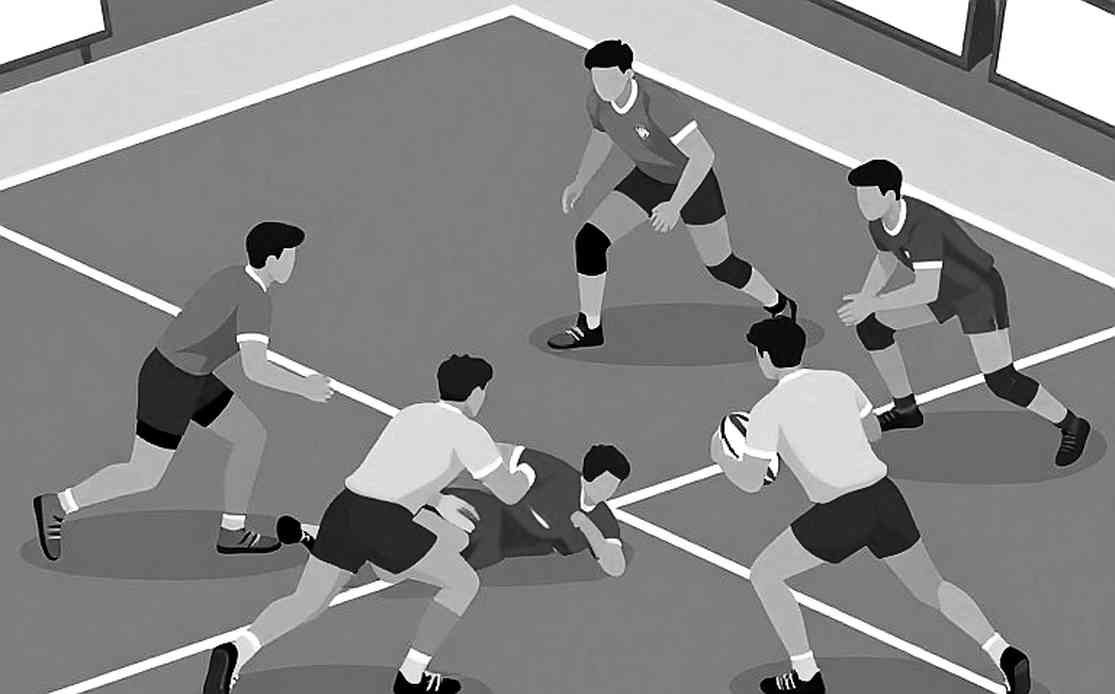
The points table supports the reading. In Group A, Bangladesh, Japan and Chinese Taipei all finished on two wins. The structure won matches; it never won anyone a big margin. In Group B, Thailand took three wins, yet in the opening ten minutes of a match their defence locked into a single pattern. A six-man protective structure can carry you to the semi-finals, but it cannot carry you to a final — because in a knockout the opponent does not need time to find your gap; he jumps into it in one second.
Score difference: a currency paid for in bodies
Three teams in Group A finished level on wins, and only one took the semi-final ticket, decided on score difference. That is where the question becomes one of sports economics. A tiebreak exists to find the better team, but its side effect is a competition in margin-building. Iran were all but through and still did not stop at anything against Thailand; Nepal, knowing their own exit was near certain, still put up 73 against Malaysia on the last day. Neither scoreline humiliated an opponent, but both kept extra minutes on bodies whose tape, pain and sleep are recorded nowhere.
In my years of watching, teams ration injury information in whatever way suits their own ledger — who is playing, who is not, surfaces sometimes and stays buried other times. At a Games this pressure doubles: a medal means funding, a medal means a job, a medal means surviving into the next cycle. So the star raider whose ankle rolled in the thirtieth minute walks back onto the mat in the fortieth, and the scoreboard carries none of it. Bangladesh's exit hurts for the same reason: two wins dissolved into a tiebreak calculation on the final day, and behind every decimal of that calculation sat five days of a squad's sleep.
Japan, Thailand, Nepal: the invisible decade before a first medal
Hosts Japan finished fourth in Group A with two wins, yet the source is right that they may emerge as a top kabaddi nation in the coming years. I would not read that as home comfort alone. Japan's method is a service method: the plan on court is legible, and mistakes do not break their rhythm. The question is the next step — the durability of a domestic league, the continuity of corporate backing, the number of mats for teenagers. Without those three, today's near-semi-final becomes tomorrow's quarter-final exit.
Thailand's first medal matters to me because it emerges from a structure that for years carried no long-term investment promise. In my own experience, writing about women's kabaddi in Bangladesh, the same question kept returning: a first medal is not an event, it is a funding cycle. A medal at a major Games buys a domestic league roughly a year of patronage, and then the cycle begins again. The hardship of the team that wins the first medal started long before the day anyone supported them.
Nepal's only win came on the last day of the league stage. It leads nowhere in the table, but its weight in sports psychology is not small. Covering the Chinese national championships in a spectatorless stadium in Shaoxing in 2026, I learned this lesson — that empty stadium taught me silence is also a crowd, and a win on the last day becomes the motivation for the next four years of training. Malaysia's ledger is different: no wins, and yet players took the mat in every match, ankles taped, trailing on the board and still reaching for the chain tackle. That effort is recorded on no table.
Pakistan's return: the arithmetic of empty hands
51-30 to Iran is not merely a defeat for Pakistan; it closes a cycle. According to the source, this is the first time they return from an Asian Games without a kabaddi medal. Behind that sentence is not a list of individual errors but a labour-market story. Pakistani kabaddi largely grows inside a departmental structure, where job security exists but matching the international calendar is hard. Domestic matches arrive months apart; an international event demands four matches in four days. The distance between the rhythm a body is used to and the rhythm it needs is exactly what returns as a third-place finish.
There is no room for patriotic sentiment here. Kabaddi is a sport where investment, public and private alike, turns on planning cycles. The question is who absorbs the miss — the federation, the department, or the defender past thirty for whom the next four years offer nothing but the risk of playing on damaged cartilage. I write about sport because this is where time becomes visible: a medal-less campaign is really a four-year ledger whose pages nobody publishes.
What 37-21 says, what 83-27 hides
An uncomfortable point belongs here: the four-wins-from-four records are the least informative data of this tournament. India and Iran are both unbeaten, and both built their large margins against opponents who had structurally collapsed that day. From 83-27 you learn more about Thailand's weak version than about Iran's best. A big scoreline never measures a team's depth; sometimes it only paints a picture of a broken afternoon.
37-21 carries more. India did nothing extra that day; what they did was the kabaddi of control — cutting raids short, taking no risk in the cover, using the clock when it suited them. Commentators sometimes read that slowness as laziness, but on the fourth day of a tournament the side that produces the same result at lower cost stays fresh on the last day. And Chinese Taipei? They lost and still advanced — because the shape of the defeat became a number, and that number exposed how fixture order itself creates advantage. Whoever meets the weakest side of a group last often decides the tiebreak. Nobody audits that detail, because on the table it looks consistent.
So what stays hidden is this: a culture of margin-building does not increase kabaddi's beauty, it reduces it. Big margins appear when one side retreats into self-protection and the other keeps the mat with an accountant's patience — shocks disappear, and a game of breath becomes a game of sums. The semi-finals will end that arithmetic. Knockouts have no score difference, only one question: who can stand through the final raid.
Three questions before September 26
Reading the conventional cross-over, India face Thailand and Iran face Chinese Taipei — group winners against runners-up, with no room for calculation. The men's gold medal match takes place on September 26, and three questions must be answered before it. First, can Thailand's and Chinese Taipei's defences survive the opening two minutes of a raid, since both were rocked in the first ten minutes of a match on the final day. Second, with the lure of score difference removed, which side can keep its best seven on the mat for the full forty minutes — a team like Japan, on home soil, is dangerous precisely for that reason, because it carries structure instead of individual spark.
The third question belongs to no scoreline and no table, but to a federation's file: for the four teams already assured of medals, where does the next two years of funding come from? And for those now going home — Bangladesh, Pakistan, Korea, Malaysia — who keeps track once they step off that same table? If a star raider goes down with a broken ankle in the final raid of a semi-final, television will make it the headline; the rehabilitation, the medical bills, the job security will all pile onto someone else's shoulders. I write about sport because this is where time becomes visible: the real outcome of any major Games shows up not in the number of medal seats, but in how many of those five teams are still standing on the mat twenty years from now.